4.6
53,701 verified reviews
About
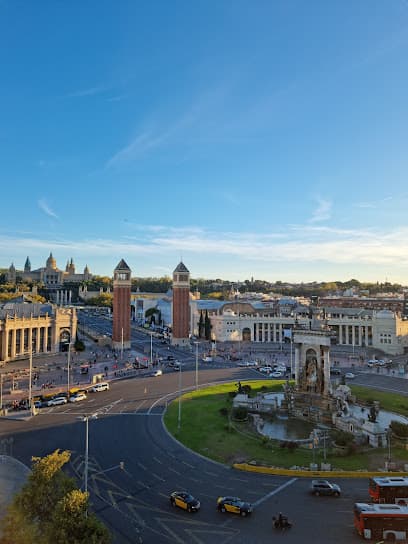
Plaça d'Espanya isn't a 'square' in the way you’re probably imagining. There are no quiet cafes with old men peeling oranges here. It is a massive, thrumming, six-way traffic circus that serves as the grand vestibule to Montjuïc. It was built for the 1929 International Exposition, a time when Barcelona wanted to prove to the world it was more than just a Mediterranean port—it was a titan of industry and art. The result is a scale that feels almost intimidating, a place designed to make the individual feel small and the state feel eternal.\n\nStanding at the center is the monumental fountain designed by Josep Maria Jujol, a collaborator of Gaudí. It’s a heavy, symbolic piece of masonry representing the seas surrounding Spain, but you’ll likely be too busy dodging scooters to contemplate the allegory. To your left and right stand the Venetian Towers, two 47-meter-high brick sentinels modeled after the campanile of St. Mark’s in Venice. They don’t lead to a canal; they lead to the Fira de Barcelona, a sprawling trade fair complex that smells of business deals and overpriced espresso.\n\nThen there’s the Arenas de Barcelona. Once a proud bullring where men faced beasts in the dust, it’s now a circular temple of global consumerism. The facade remains—a beautiful Neo-Mudéjar shell—but inside it’s all Zara, H&M, and the hum of escalators. Here’s the pro tip: don’t pay the couple of euros for the external glass elevator that takes you to the roof. It’s a tourist tax for the impatient. Walk inside the mall, take the internal escalators to the top floor for free, and walk out onto the terrace. From there, you get a 360-degree punch to the gut: the Tibidabo mountain in the distance, the Sagrada Família peeking over the skyline, and the straight-shot view up the Avinguda de la Reina Maria Cristina toward the National Art Museum (MNAC).\n\nSpeaking of that view, it’s one of the best things to do in Barcelona, especially as the sun starts to dip. You’ll see the Magic Fountain of Montjuïc sitting in the middle of the ascent. In the 'before times,' this was a nightly spectacle of light, music, and water. These days, thanks to Catalonia’s persistent drought, the fountain is often dry, a silent reminder that nature always bats last. Even without the water, the walk from the plaza toward the museum is essential. You pass the trade fair pavilions and start the climb—aided by outdoor escalators because, let’s be honest, it’s hot—until you reach the steps of the MNAC. Turn around there, and you’ll see Plaça d'Espanya for what it really is: a grand, chaotic, beautiful mess that anchors the city.\n\nIs it a tourist trap? Parts of it, sure. The restaurants immediately ringing the plaza are largely forgettable, serving frozen croquetas to people who don't know any better. But as a piece of urban theater, it’s unbeatable. It’s where the city holds its breath before climbing the hill. It’s loud, it’s crowded, and the air tastes like bus exhaust, but you haven't seen Barcelona until you've stood in the shadow of those towers and felt the weight of the 1929 dream pressing down on you.
Type
Tourist attraction
Duration
1-2 hours
Best Time
Late afternoon to catch the sunset from the Arenas rooftop.
What People Say
shopping center(693)magic fountain of montjuïc(468)bullring(325)metro(267)escalators(97)1929(45)pickpockets(41)neuralgia(35)
Features
Tourist attraction
Categories
ArchitectureHistoryPublic SquarePhotography
Ticket Prices
Free Admission
No tickets required
Must-See Highlights
The 360-degree view from the Arenas rooftop terrace
The Venetian Towers at the start of Avinguda de la Reina Maria Cristina
The central fountain designed by Josep Maria Jujol
The view looking up toward the Palau Nacional (MNAC)
Visitor Tips
Avoid the external glass lift at Arenas; use the mall escalators for free.
Be wary of pickpockets, as this is a major transit hub and tourist crossing.
Check the drought status of the Magic Fountain before planning a night visit.
Use the underground passages to cross the busy traffic circle safely.
Good For
PhotographersArchitecture buffsBudget travelersFamilies
Why Visit
The Arenas Rooftop: A former bullring offering the best free 360-degree panoramic view of the city skyline.
The Venetian Towers: Imposing 47-meter brick towers that serve as the grand entrance to the Montjuïc hill.
Access to the Arts: Direct walking access to the Magic Fountain, Poble Espanyol, and the National Art Museum (MNAC).
Nearby Landmarks
- Magic Fountain of Montjuïc (5-minute walk)
- Arenas de Barcelona Shopping Centre (1-minute walk)
- Poble Espanyol (12-minute walk)
- Museu Nacional d'Art de Catalunya - MNAC (15-minute walk)
- Parc de Joan Miró (5-minute walk)
Accessibility
- Fully wheelchair accessible plaza
- Elevators available in Arenas shopping center
- Escalators available for the climb toward MNAC
Location
Pl. d'Espanya
Sants-Montjuïc, Barcelona
Nearby Hotels
Nearby Restaurants
In Sants-Montjuïc
ATTRACTION
Bolets1
Sants-Montjuïc
A gritty, earthy temple to the Catalan obsession with wild mushrooms, where the dirt is real, the fungi are seasonal gold, and the air smells like the damp floor of a Pyrenean forest.
0.0(0)
Tourist attraction
ATTRACTION
Montjuic aparca
Sants-Montjuïc
The unglamorous base camp for your Montjuïc assault. A tactical slab of asphalt where the city's chaos fades into the pine-scented ghosts of the 1992 Olympics.
0.0(0)
Tourist attraction
ATTRACTION
Паркінг Барселона
Sants-Montjuïc
A sprawling slab of industrial reality in the Zona Franca. No Gaudí here—just hot asphalt, diesel fumes, and the honest utility of a secure place to park your rig.
0.0(0)
Park
Frequently Asked Questions
Is Plaça d'Espanya worth visiting?
Yes, primarily as a gateway to Montjuïc and for the free 360-degree views from the top of the Arenas shopping center. It is one of Barcelona's most recognizable architectural ensembles.
Is the Magic Fountain currently working?
As of 2024-2025, the Magic Fountain is frequently turned off or operating on a very limited schedule due to drought restrictions in Catalonia. Check the official Barcelona city council website for current status before visiting.
How do I get to Plaça d'Espanya?
It is a major transport hub accessible via Metro lines L1 (Red) and L3 (Green), as well as several FGC train lines and the Aerobús from the airport.
Do I have to pay to go to the top of the Arenas bullring?
No. While the external glass elevator charges a small fee, you can enter the shopping mall and use the internal escalators to reach the rooftop terrace for free.
Reviews
0 reviews for Plaça d'Espanya
No reviews yet. Be the first to share your experience!